Rouge H2 Engineering and AMBARtec are collaborating on the EU project H2LOOP


At the end of 2025, a meeting of all partners in the European H2Loop project took place at Acciaierie d'Italia in Extraordinary Administration in Taranto. The initiative is co-financed by the European Commission as part of the RFCS-BIG TICKET programme.   

Rouge H2 Engineering AG is a technology provider in the EU project H2LOOP for decarbonising the steel industry. Rouge H2 Engineering AG provides the technology in the form of its patented chemical looping process (CLH), which is used to produce hydrogen from metallurgical gases. The project focuses on developing innovative solutions for the sustainable production of hydrogen from blast furnace gases and the associated contribution to the decarbonisation of the steel sector.  

AMBARtec AG provides technological support. Rouge H2 Engineering is supported by AMBARtec AG, its partner company, whose colleagues have extensive experience with the iron oxide nuggets used in CLH and in scaling up the process.
 

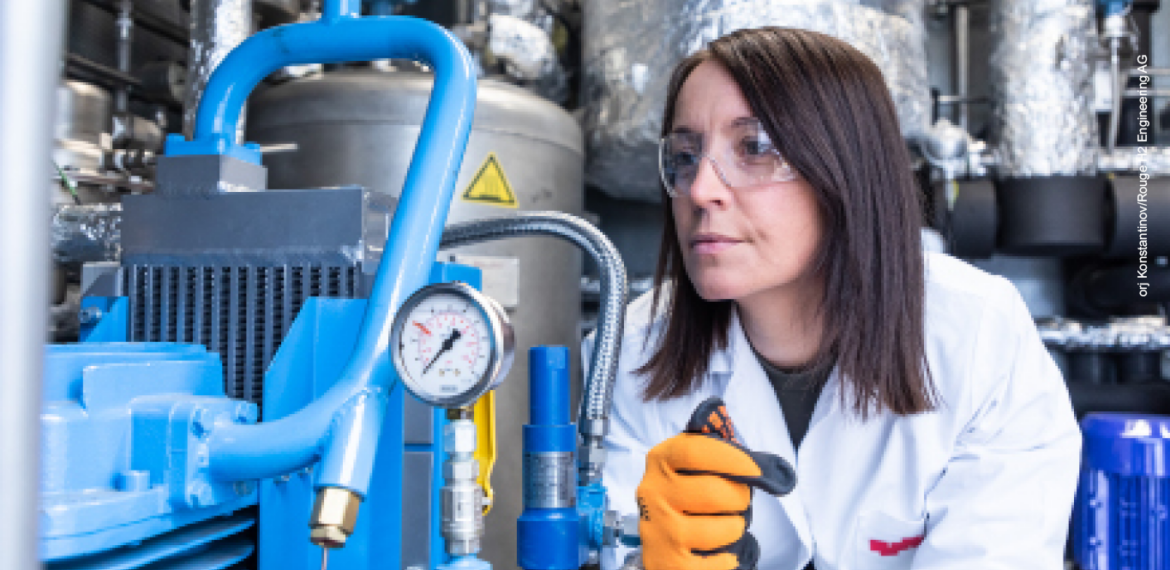
Picture above: Trial operation at Rouge H2 Engineering © Rouge H2 Engineering


Three other partners are involved in the four-year project: VDEh-Betriebsforschungsinstitut GmbH (BFI), a German research center with over 50 years of experience in the steel industry; Acciaierie d'Italia in Extraordinary Administration, Italy's largest steel mill, where a corresponding pilot plant is being implemented; and the Polytechnic University of Turin, a leading Italian university in the field of engineering.  

The primary goal of H2Loop is to demonstrate the feasibility and efficiency of the proprietary chemical looping process (CLH) in generating hydrogen from metallurgical gases. This solution could accelerate the sustainable transformation of the steel industry by reducing CO₂ emissions and enabling the production of hydrogen for industrial use.

More about H2Loop 

* Funded by the European Union. Views and opinions expressed are however those of the authors only and do not necessarily reflect those of the European Union or the European Research Executive Agency (REA). Neither the European Union nor the European Research Executive Agency (REA) can be held responsible for them.

Pressekontakt:  

Dr. Ines Bilas

AMBARtec AG

Head of Marketing and Communication

Phone:  +49 172 234 11 00

E-Mail: ines.bilas@ambartec.de

Website: www.ambartec.de 
Hydrogen Technology Expo: AMBARtec enables CHP operators to partially switch to hydrogen


A first step towards climate-neutral municipal heat supply.
DRESDEN, 17 October – At the Hydrogen Technology Expo (21–23 October) in Hamburg, AMBARtec will show how municipal utilities can run their combined heat and power plants (CHP) partially with hydrogen at low cost, thereby greatly reducing their CO2 emissions. This can be done by mixing hydrogen with natural gas. It works thanks to iron oxide hydrogen storage systems. No infrastructure conversion is required. Visitors to the AMBARtec stand in Hall 2, Stand E15, can find out how they can convert their power plants.

20% hydrogen without changing how energy is produced.
'You can add up to 20% hydrogen to natural gas without having to replace the gas engines you already have,' says Matthias Rudloff, the CEO of AMBARtec. 'Our iron oxide-based storage systems are not classified as hazardous materials, so there is no need for them to undergo lengthy approval procedures or to have additional special safety measures in place. Operators of CHP plants only need a discharging unit; the hydrogen is delivered to them in containers via iron nuggets.'

Keep operating costs stable
Adding a maximum of 20% hydrogen has only a very minor impact on operating costs. It is also possible to purchase low-cost hydrogen from AMBARtec's partner network, which is currently significantly cheaper than electrolysis hydrogen. This is recycled hydrogen from a closed-loop system: Numerous companies and research institutions produce hydrogen that is released into the environment unused for technological and economic reasons. AMBARtec's storage systems can absorb it and in this way the hydrogen can bei reused safely and cost-effectively.  

Achieving sustainability goals
The gradual conversion of municipal heat supply to climate-friendly hydrogen makes a substantial contribution to enabling cities and municipalities to meet their sustainability obligations. ‘By adding hydrogen in a first step, municipal energy suppliers can also gain initial experience with this energy source without fundamentally changing their operating procedures or requiring high investments. The iron nuggets are transported in conventional 20-foot containers by truck. This means that every municipal utility can be reached easily and quickly,’ says Matthias Rudloff, pointing out further advantages.  

About AMBARtec:  
AMBARtec AG, based in Dresden, is an innovation leader in the field of iron oxide-based hydrogen storage systems. The process consists of the reduction and oxidation of iron oxide or iron: During storage, the added hydrogen reduces the iron oxide storage medium. The vapor released in the process can be reused in electrolysis. During discharge, water vapour is added to the storage unit at the point of use. This causes the iron to oxidise, releasing hydrogen.

The results of multi-stage practical tests at the demonstration plant in Freiberg confirm the excellent energy balance of the entire process, from hydrogen production to storage unit filling, transport and discharge of the hydrogen. Optimum system integration of high-temperature electrolysis (SOEC) enables efficiencies of more than 80 per cent to be achieved. The possible applications of the AMBARtec storage system range from highly efficient energy storage to the safe transport of hydrogen, even over long distances, and hydrogen drives in shipping.

In collaboration with Rouge H2 Engineering AG, AMBARtec also offers an alternative process based on iron oxide nuggets to produce high-purity hydrogen from dirty gases such as blast furnace gases and synthesis gases from biogenic residues or sewage sludge. Together with CCS/U, this steam-iron process could make steelworks climate-neutral at a reasonable cost.

Press contact:  

Dr. Ines Bilas

AMBARtec AG

Head of Marketing and Communication

Phone:  +49 172 234 11 00

E-Mail: ines.bilas@ambartec.de

Website: www.ambartec.de 
The Path to a Climate-Neutral Steel Mill. Interview with AMBARtec, Part II


The success of the German steel industry in decarbonising its production processes depends on the technological processes involved. In the first part of the marketSTEEL interview, AMBARtec CEO Matthias Rudloff presented the iron-steam process as a cost-effective and less labour-intensive alternative to direct reduction.  

However, economic policy conditions also play a decisive role. Dagmar Dieterle, editor and founder of the information platform, asked Matthias Rudloff for his assessment on this topic as well.  

Read the current part of the interview here. (only available in German).  

The first part of the interview, published in July, can be read here.  

The Path to a Climate-Neutral Steel Mill. Interview with AMBARtec


The German steel industry faces the challenging task of decarbonising its production processes. However, previous strategies, such as direct reduction with hydrogen, have various disadvantages. The iron-steam process is a cost-effective alternative that can be implemented with significantly less effort.

Dagmar Dieterle, editor and founder of marketSTEEL — the information platform for the steel and metal industry — spoke with Matthias Rudloff, CEO of AMBARtec, about this topic.  

Read the first part of the interview here (only available in German).  

The second part will be published at the end of September.